

Showing posts with label maps. Show all posts
Showing posts with label maps. Show all posts
Saturday, April 25, 2020
Meanwhile, in the Woods...
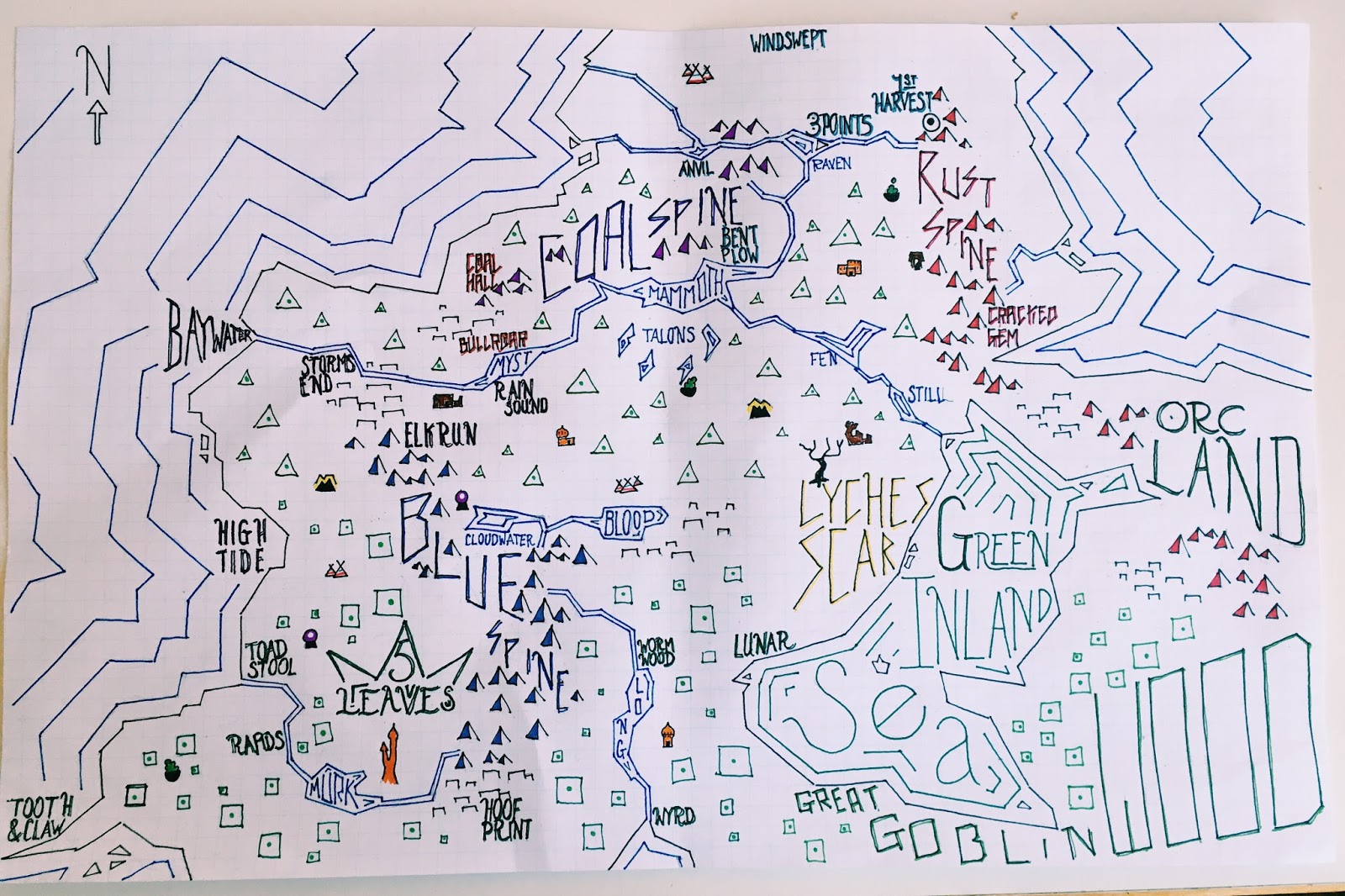
The DM-facing hexmap from a double-secret project that I hope will only be single-secret before too long. I stole the concept from Matthew Adams.


Monday, April 2, 2018
How to Add Entries to the Hex Describe Bible (With Pictures!)
Want to get involved in the world's most comprehensive hexcrawl generator, but don't know where to start? Why, you've come to the right place! I am not a coder - not by a long shot - but I figured Hex Describe out, and you can too. Here's the easiest way to help this project out.
1. Find that blog post, Word doc, notebook, or crumpled up napkin with the hex descriptions, encounters, NPCs, or items you like. Maybe you only have one or two. That's ok. No contribution is too small. We're like fuckin' NPR that way. Let's say all you have is this:


1. Find that blog post, Word doc, notebook, or crumpled up napkin with the hex descriptions, encounters, NPCs, or items you like. Maybe you only have one or two. That's ok. No contribution is too small. We're like fuckin' NPR that way. Let's say all you have is this:
- A clear pool hidden in a rocky ravine where moss hulks and lichen dryads can often be found playing. At the bottom lies the golden hand mirror of a lady of the Seelie Fey court.
- 2d6 hungry wolves
2. First, let's put it in the right format. You need to start each entry with a number and a comma. The number essentially represents the number of times the entry appears on the table. The pool sounds pretty rare, but maybe you want the wolves to be more common. Put [brackets] around dice rolls, and the program will roll it for you. Also, put the most important parts of the entry in bold by surrounding them with *asterisks*. Maybe you could add a few simple stats while you're at it, for convenience, and flesh out the behavior of those wolves:
- 1,A *clear pool* hidden in a rocky ravine where *moss hulks* (HD 7 AC 17 crush d10) and *lichen dryads* (HD 3 AC 15 whip d6 + charm) can often be found playing. At the bottom lies the *golden hand mirror* of a lady of the Seelie Fae court.
- 3,*[2d6] hungry wolves* (HD 3 AC 14 bite 2d4) begin to stalk the party. They will wait for a moment of vulnerability to strike.
3. Now we're set to add them. Go to the Hex Describe Bible.

4. Make sure the outline is visible by checking View -> Show document outline.

5. Scroll down on the outline to Wilderness Tables and decide which terrain type (or types) your entries are most appropriate for. I'd say "fir-forest" sounds pretty good for these. Click on the terrain type to go there in the doc.

6. There are four tables for each terrain type: landmarks, encounters, NPCs, and items. Decide where each of your entries fits best. I'd say my first entry is a landmark and the second is an encounter.
7. Copy and paste under the table heading, which always begins with a semicolon. So I'd paste the first entry under ";fir-forest landmarks," and the second under ";fir-forest encounters."

That's it! When you paste it into Hex Describe, you might now get a hex description like this:
0101: Boreal forest.
Landmark: A clear pool hidden in a rocky ravine where moss hulks (HD 7 AC 17 crush d10) and lichen dryads (HD 3 AC 15 whip d6 + charm) can often be found playing. At the bottom lies the golden hand mirror of a lady of the Seelie Fae court.
Encounter: 2 hungry wolves (HD 3 AC 14 bite 2d4) begin to stalk the party. They will wait for a moment of vulnerability to strike.
NPC: none
Item: none
Landmark: A clear pool hidden in a rocky ravine where moss hulks (HD 7 AC 17 crush d10) and lichen dryads (HD 3 AC 15 whip d6 + charm) can often be found playing. At the bottom lies the golden hand mirror of a lady of the Seelie Fae court.
Encounter: 2 hungry wolves (HD 3 AC 14 bite 2d4) begin to stalk the party. They will wait for a moment of vulnerability to strike.
NPC: none
Item: none
You can get fancier by using subtables and reading +Alex Schroeder's tutorial here, but you don't have to! Give yourself the gift of knowing you've contributed to something that may someday make countless DMs' lives that much easier.
Saturday, March 31, 2018
Help Make Hex Describe the Best Thing Ever

A little while ago, +Zak Sabbath posted this on G+:
"Here's what I want:
A program that writes an entire setting book using a variety of the existing random OSR tables online.
(Like Last Gasp and Abuafia's automated crowdsourced random generators)
It generates a random map using an existing random map program, then for each area it generates random contents using an existing random hex contents widget, for each village it generates a random village using existing random village generators, for each dungeon it generates random rooms, for each room it generates random contents, for each creature it generates a personality and stats and a history, etc etc fractally all the way down."
The last comment in the thread was +Alex Schroeder casually dropping a link to his web app Hex Describe. It fucking rules.
It generates the contents of a list of hexes by pulling from tables for each hex type using Abulafia formatting. So if your hex list was:
0101 forest
You could have a table like this:
;forest
1,A stone bridge crosses a valley stream, under which a troll lurks.
1,A pack of wolves makes its den here, which is strewn about with coins from previous victims.
2,A merchant has broken a cart wheel and offers reward either to fix the cart or otherwise transport her and her goods to the nearest town.
The numbers before each entry are weights, so the merchant entry has a 2/4 chance of being selected, while the other two only have a 1/4 chance. You can also have sub-tables, so you could alter the table in this way:
;forest
1,A stone bridge crosses a valley stream, under which a troll named [troll name] lurks.
1,[group of beasts] makes its den here, which is strewn about with coins from previous victims.
2,A [goods] merchant has broken a cart wheel and offers reward either to fix the cart or otherwise transport her and her goods to the nearest town.
;troll name
1,Harnfling
1,Firbin
1,Dogrunt
1,Wrungle
;group of beasts
1,A pack of wolves
1,A pride of lions
1,An ambush of tigers
1,A bear
;goods
1,salt
1,clothes
1,medicine
1,shoes
Things can get pretty complex just by typing out a long list of tables. And, in fact, Alex already has a damn impressive example here.
The more I play with and read about it, the more I'm convinced this is the program that can do what Zak was asking. OSR folks just need to get together and build the library to support it.
So in that spirit, I'm creating The Hex Describe Bible, a library for Alex's Hex Describe set up to be built by Gygaxian Democracy. My ambition is for it to grow into nothing less than the definitive source for random hex contents generation. I want this thing to be over 500 pages long and inspire awe in those who use it. I want people to talk about hexcrawls in terms of "before Hex Describe" and "after Hex Describe".
But for that to happen, I need you. All of you. I'm sure you have at least a few hex descriptions lying around. Add them to the Hex Describe Bible under the most appropriate hex type. It's set up to spit out hex descriptions like this:
0101: Bush.
Landmark: Several ant mounds at least 20 feet tall dot the horizon. Food, even in large quantities, tends to go missing here.
Encounter: Scrub brush hides an opening to a deep pit. At the bottom lie the skeletal remains of an unlucky traveler holding scissors.
NPC: a human fighter (lvl 2) named Nayara who can inspire another character to perform an extra non-attack, non-spellcasting action once per fight and can disarm an opponent on a successful hit if they fail a strength check. Is generous and motivated by family. Wields a longbow. Carries 10 days’ rations, a taxidermied animal, priest's robes, and priest's robes.
Item: A thorny shrub oozes sap that can be used as a powerful adhesive. Can only be removed with goblin urine.
Landmark: Several ant mounds at least 20 feet tall dot the horizon. Food, even in large quantities, tends to go missing here.
Encounter: Scrub brush hides an opening to a deep pit. At the bottom lie the skeletal remains of an unlucky traveler holding scissors.
NPC: a human fighter (lvl 2) named Nayara who can inspire another character to perform an extra non-attack, non-spellcasting action once per fight and can disarm an opponent on a successful hit if they fail a strength check. Is generous and motivated by family. Wields a longbow. Carries 10 days’ rations, a taxidermied animal, priest's robes, and priest's robes.
Item: A thorny shrub oozes sap that can be used as a powerful adhesive. Can only be removed with goblin urine.
Over the next week I'll be filling out more and more of the tables and highlighting some of the things this can do on my blog. But I can't do this alone. Even if you don't want to contribute, please share with people who might.
I need you. Your hexmap needs you. Let's do this.
EDIT: If everyone who read this post added just one hex description to the doc, we'd have 1600+ by now. Just sayin'. If you found this blog, chances are you've written at least ONE hex you're proud of in your whole life. Go add it right now. I've written a tutorial for exactly how to get started here. If you have a big table to format, check this out.
EDIT: If everyone who read this post added just one hex description to the doc, we'd have 1600+ by now. Just sayin'. If you found this blog, chances are you've written at least ONE hex you're proud of in your whole life. Go add it right now. I've written a tutorial for exactly how to get started here. If you have a big table to format, check this out.
Friday, February 10, 2017
The Free-Association Map Method
The players in my Malara campaign have recently reached 5th level and secured a relatively steady income by marrying a prostitute friend of theirs off to the royal botanist and then assassinating and impersonating said botanist (like you do). As such, they're starting to feel a bit of wanderlust. Up to this point, they've spent most of the campaign in a huge primeval forest and adjacent jungly elf empire (toward the center of the map below).

So the time has finally come for me to figure out what else is out there. This is how I did that.
First: codify my influences. I filled a piece of paper haphazardly with the stuff I want to influence the setting. Then, around each one, I tried to get more specific about what aspects I wanted to lift for my game.

Then I moved on to the word-map below. Using the influences and what I've already told the players, I named the regions of the game world. I used different colors to distinguish the regions from each other and provide a dominant mood. Around each region, I filled in words from the previous step, crossing them out as I went.
Then it was a matter of making several more passes, using what was already there to free-associate more characteristics of the region. At this point I also borrowed liberally from other sources, particularly +Zak Sabbath's campaign (the prime motivation behind this).

For every region, I tried to make sure I included most of these:
Then it was a matter of making several more passes, using what was already there to free-associate more characteristics of the region. At this point I also borrowed liberally from other sources, particularly +Zak Sabbath's campaign (the prime motivation behind this).

For every region, I tried to make sure I included most of these:
- Landscape
- Monsters
- Political actors
- Flavor
- Two dungeon-like adventure locations, outlined in yellow. Eventually I hope to have 5-10 for each region (if they get visited, anyway), but at least I can quickly create these two if I know the PCs are on the way.
As a final step, I demarcated land, allies, enemies, trade routes, and wrote a hook for each region.
This method might be too obvious to warrant a post ("I wrote down ideas in different colors!"), but I was really happy with both the process and result. It gave me more freedom and more useful information than my usual mapmaking inclination, which is to start by outlining continents, then mountains, then rivers, then forests...and then the last step is, "Ok, so what goes here? Why do the PCs care?" Essentially, I inverted the process. Now I feel like I have a really good idea of what each location is like, and can quickly produce a map that should give the PCs enough to do until I can flesh it out some more.
Friday, February 3, 2017
Beyond Vornheim
Read these:
Mandy:
Facebook
Google+
Zak:
Blogger
In the absence of hard evidence on either side, you need to decide for yourself whose words are more credible. For my part, I find Mandy more credible because I can see Zak's great incentive to lie, but I can't see hers. I've decided to withdraw my support for Zak - through both my money and my blog - unless I can be absolutely certain that I'm not supporting the person Mandy describes. I wouldn't send someone to jail based on this level of evidence, but I'm not sending him to jail so that standard doesn't apply. The only things I know for sure about Zak are that he makes good RPG material and is unnecessarily combative online, and those things neither condemn nor exonerate him.
Mandy:
Google+
Zak:
Blogger
In the absence of hard evidence on either side, you need to decide for yourself whose words are more credible. For my part, I find Mandy more credible because I can see Zak's great incentive to lie, but I can't see hers. I've decided to withdraw my support for Zak - through both my money and my blog - unless I can be absolutely certain that I'm not supporting the person Mandy describes. I wouldn't send someone to jail based on this level of evidence, but I'm not sending him to jail so that standard doesn't apply. The only things I know for sure about Zak are that he makes good RPG material and is unnecessarily combative online, and those things neither condemn nor exonerate him.
Friday, February 26, 2016

Subscribe to:
Posts (Atom)